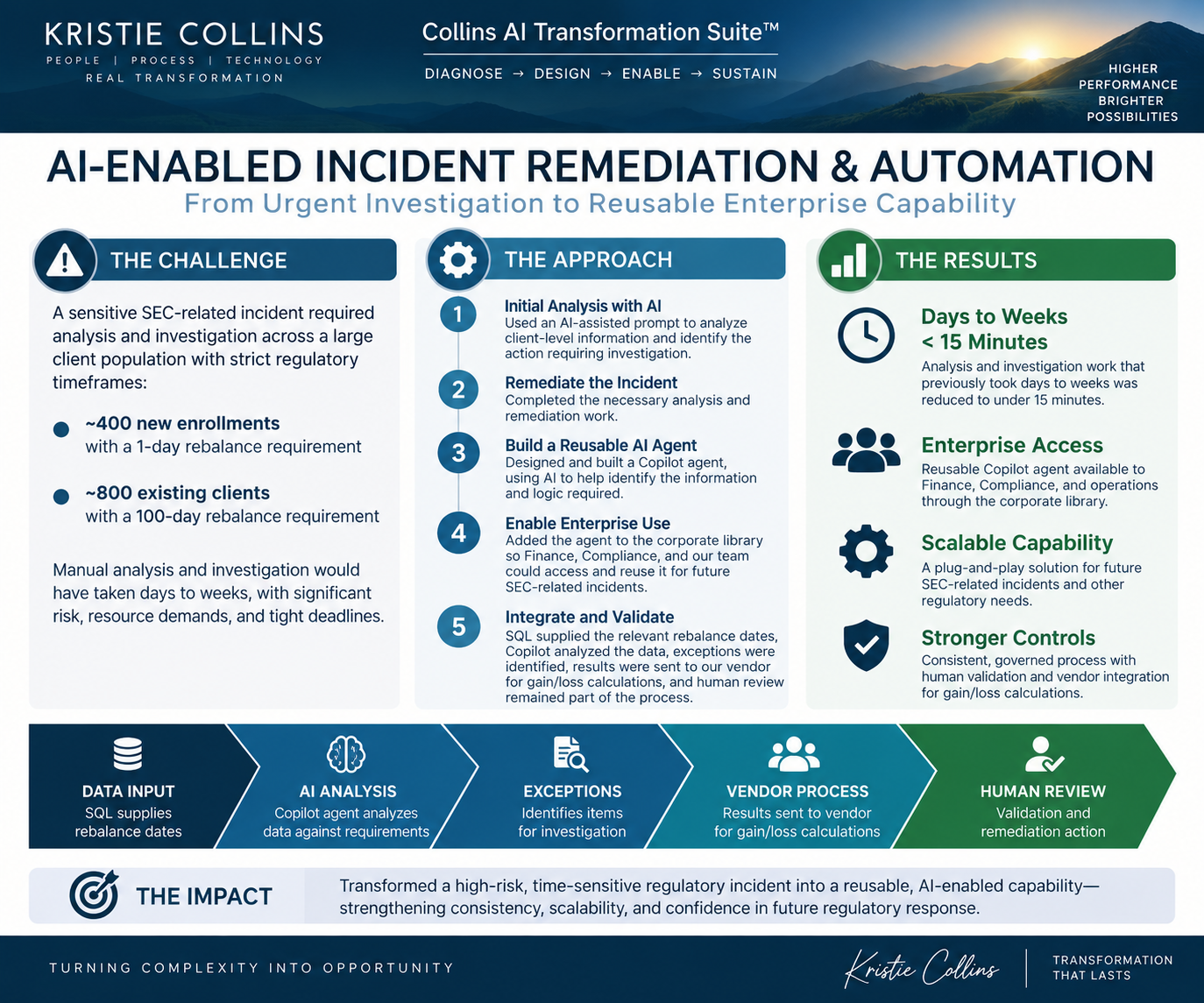
AI-Enabled Incident Remediation & Automation
The Challenge
A regulatory incident required analysis and investigation across a large, complex client population with different requirements and tight deadlines. The recordkeeper provided information identifying approximately 5,000 clients as potentially impacted, but the organization did not yet know which individuals were actually affected or what action was required for each client.
Manual analysis and investigation would have required substantial time and resources while creating operational and regulatory risk.
The Approach
The work evolved from a broad manual investigation into a reusable AI-enabled capability. Key activities included:
Exploring and defining the investigation scope.
Gathering and analyzing approximately 5,000 client records.
Using AI-assisted analysis to identify potential exceptions and required actions.
Completing the remediation analysis and documenting results.
Designing and building a reusable Copilot agent.
Integrating the agent into the enterprise environment.
Validating results against source data and maintaining human review.
My Role
I helped define the problem, shape the AI-enabled solution, and develop the approach for transforming a one-time investigation into a repeatable capability. I worked through the analysis, exception identification, remediation requirements, and design of a reusable Copilot agent, with human validation and appropriate review retained in the process.
The Results
Reduced analysis and investigation work from days to weeks to under 15 minutes.
Identified approximately 400 new enrollments requiring action within one day.
Identified approximately 800 existing clients requiring action within 100 days.
Determined that approximately 3,800 clients required no action.
Created a reusable AI-enabled capability for future incidents.
Established an approach that could be extended to other operational and regulatory investigations.
What This Demonstrates
AI transformation, process redesign, intelligent automation, regulatory operations, data analysis, human oversight, exception management, reusable AI capabilities, and scalable business value.