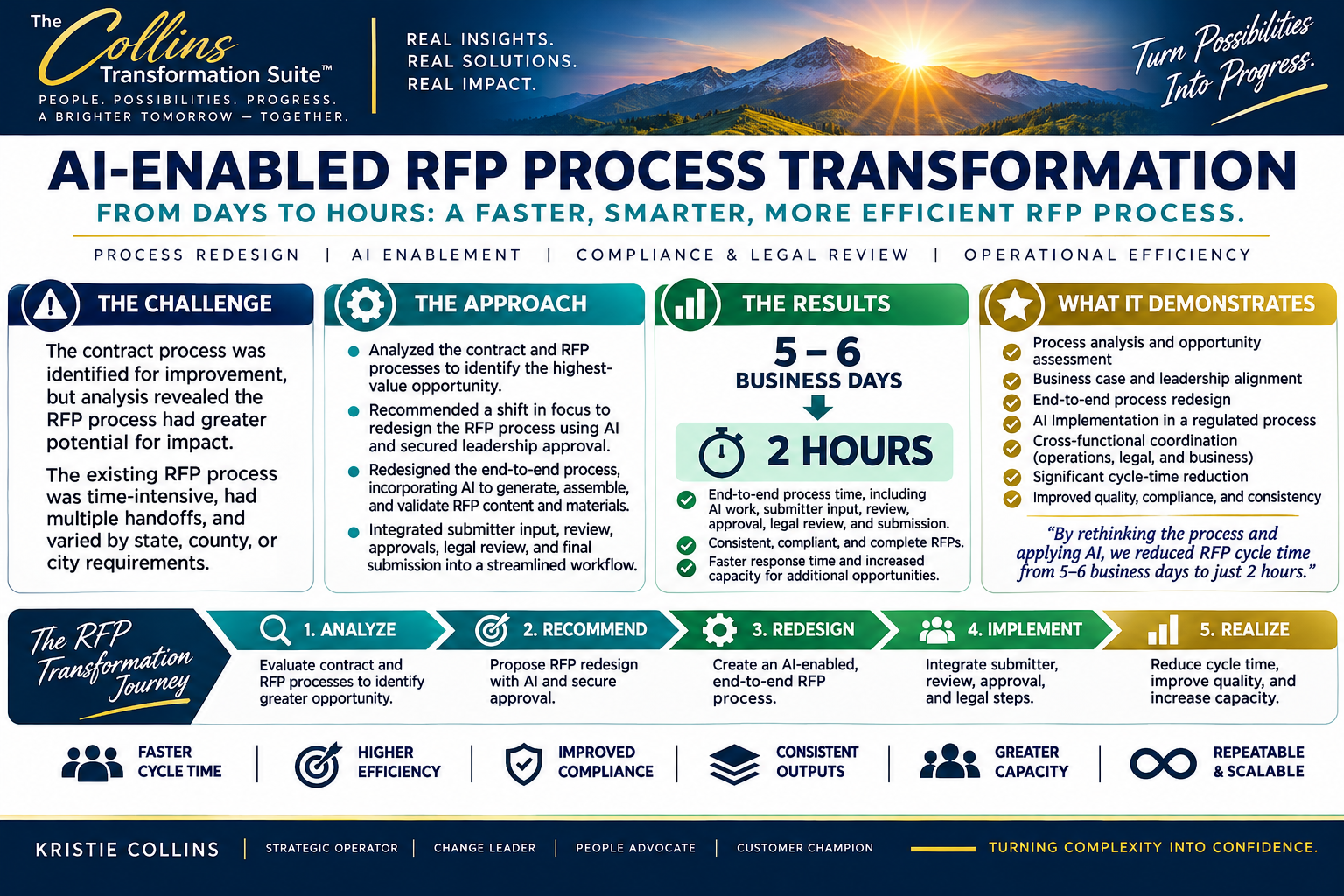
AI-Enabled RFP Process Transformation
From Five to Six Business Days to Approximately Two Hours
The Challenge
The initial request was to explore how AI could improve the organization's contract process. However, analysis of the broader workflow revealed a greater opportunity earlier in the business process: the Request for Proposal (RFP) response process.
RFP responses were time-consuming and involved multiple contributors, reviews, approvals, and legal requirements. The process could take five to six business days, limiting the organization's ability to respond efficiently and manage additional opportunities.
The Insight
Rather than applying AI to the originally identified contract process, I evaluated the upstream workflow and identified RFP response preparation as the higher-value opportunity.
I presented the recommendation to leadership, secured approval to shift the focus, and helped redirect the effort toward an AI-enabled redesign of the end-to-end RFP process.
The Approach
The redesigned process combined structured content, AI-assisted drafting, and defined human review and approval.
Key elements included:
Reusable approved content: A centralized library of approximately 14,000 response-ready answers, reviewed through Marketing, Compliance, and Legal.
AI-assisted response drafting: AI retrieved and assembled relevant answers from the approved content library to prepare an initial response.
Defined human review: An RFP representative reviewed the generated response for completeness and accuracy.
Legal review and sign-off: The completed response moved through Legal for final approval.
Redesigned workflow: The process connected AI activity, submitter responsibilities, review, approval, and final submission into a more coordinated sequence.
My Role
I was initially asked to examine opportunities to improve the contract process. Through process analysis, I identified the upstream RFP response process as the stronger opportunity for improvement.
I developed and presented the recommendation, obtained leadership approval to redirect the effort, and contributed to the process redesign and AI-enabled workflow implementation.
The Results
Five to six business days → approximately two hours
The redesigned process reduced end-to-end RFP response preparation time to approximately two hours.
The new workflow included:
Approximately 15 minutes for AI-assisted drafting from the approved response library.
Approximately 45 minutes for RFP representative review.
Typically one hour or less for final Legal review and sign-off.
The improvement reflected the complete process—not simply the time required for AI to generate a draft.
What This Demonstrates
This engagement illustrates the value of looking beyond the initial technology request to understand the broader business process.
The greatest opportunity may not be where an organization first expects it to be. By examining the upstream workflow, identifying the highest-value intervention, and designing around both technology and human accountability, AI can deliver meaningful operational improvement without removing the controls that matter.
The lesson: Better transformation starts with understanding the work—not simply applying technology to the process someone first identifies.