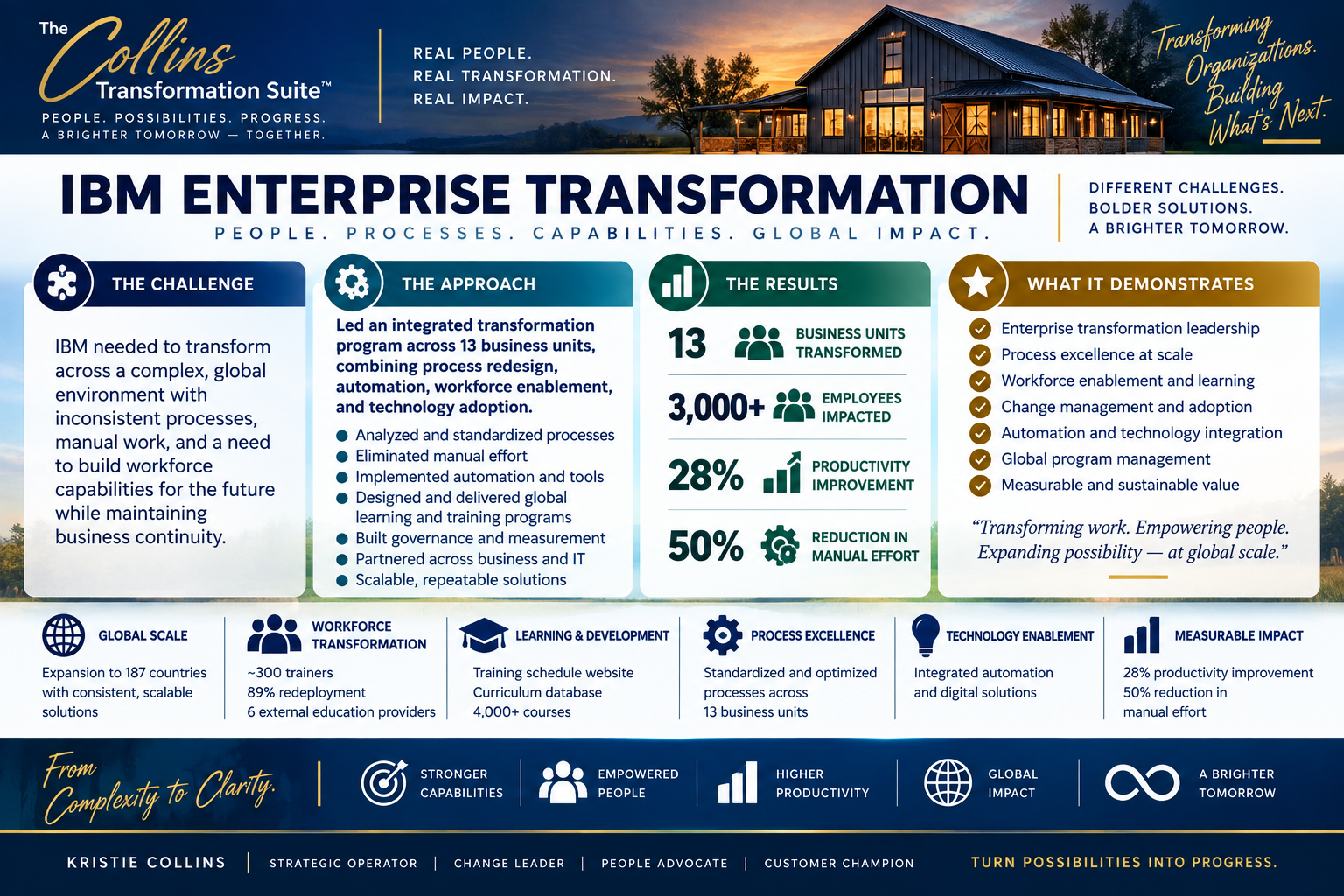
IBM Enterprise Transformation
The Challenge
IBM needed to transform a complex, global environment characterized by inconsistent processes, manual work, and a need to build workforce capabilities for the future while maintaining business continuity. The organization required scalable solutions that could improve productivity, standardize operations, and enable employees across multiple business units.
The Approach
The transformation involved an integrated program across 13 business units, combining process redesign, automation, workforce enablement, and technology adoption. Key activities included:
Analyzing and standardizing processes.
Eliminating manual effort through centralized tools and improved workflows.
Implementing automation and technology solutions.
Designing and delivering global learning and training programs.
Building governance and measurement capabilities.
Partnering across business and IT functions.
Establishing scalable, repeatable solutions.
My Role
I led and coordinated enterprise transformation initiatives across business units, connecting process excellence, workforce enablement, technology adoption, and operational governance. My responsibilities included developing standardized processes, implementing productivity improvements, coordinating learning and development initiatives, and supporting global workforce and operating-model changes.
The Results
Transformed operations across 13 business units.
Impacted more than 3,000 employees.
Improved productivity by 28%.
Reduced manual effort by 50%.
Supported an 89% internal workforce redeployment rate during an outsourcing-related transition.
Expanded scalable operating and learning capabilities globally.
What This Demonstrates
Enterprise transformation leadership, process excellence at scale, workforce enablement, automation and technology integration, change management, global program management, and measurable business value.